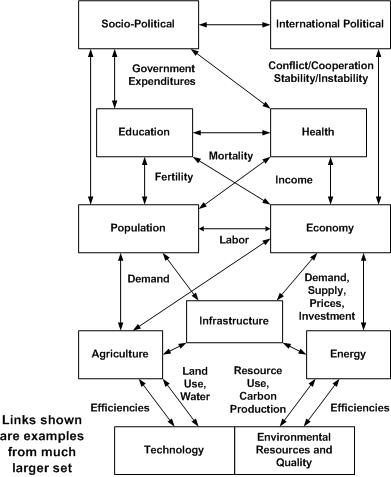
== [[File:IFsOverviewChart.jpg|frame|right|Overview of the IFs model and sub-modules.]]IFs Issues and Modules: Visual Representation ==
== [[File:IFsOverviewChart.jpg|frame|right|Overview of the IFs model and sub-modules.]]IFs Issues and Modules: Visual Representation ==
Among the philosophical premises of the International Futures (IFs) project is that the model cannot be a "black box" to users and be truly useful. Model users must be able to examine the structures of IFs in order (1) to have confidence in them, and (2) learn from them.
== Dominant relations ==
Any computer simulation or other model will have some relationships and dynamics that dominate the behavior of the model and that therefore most heavily influence the analyses done with the model. Understanding these dominant relations will facilitate model use, particularly in the definition of key or framing scenarios.
The value added by more detailed specification of relationships in the model will lie partly in more probing analysis, often around specific policy options. Much of the value added by a more complete model specification will, however, lie in the dynamics of the full model.
For an introductory summary of dominant relations and dynamics by submodule:
Social/Political Change: Life expectancy, literacy rate, democracy level, status of women, value change
Demographic Futures: Population levels and growth, fertility, mortality, migration
Food and Agriculture: Land use and production levels, calorie availability, malnutrition rates
Energy: Resource and production levels, demand patterns, renewable energy share
Economics: Sectoral production, consumption, and trade patterns and structural change
Global System: Country and regional power levels
Overview of the IFs model and sub-modules.IFs Issues and Modules: Visual Representation
Among the philosophical premises of the International Futures (IFs) project is that the model cannot be a "black box" to users and be truly useful. Model users must be able to examine the structures of IFs in order (1) to have confidence in them, and (2) learn from them.
Dominant relations
Any computer simulation or other model will have some relationships and dynamics that dominate the behavior of the model and that therefore most heavily influence the analyses done with the model. Understanding these dominant relations will facilitate model use, particularly in the definition of key or framing scenarios.
The value added by more detailed specification of relationships in the model will lie partly in more probing analysis, often around specific policy options. Much of the value added by a more complete model specification will, however, lie in the dynamics of the full model.
For an introductory summary of dominant relations and dynamics by submodule: