== IFs Issues and Modules: Visual Representation ==
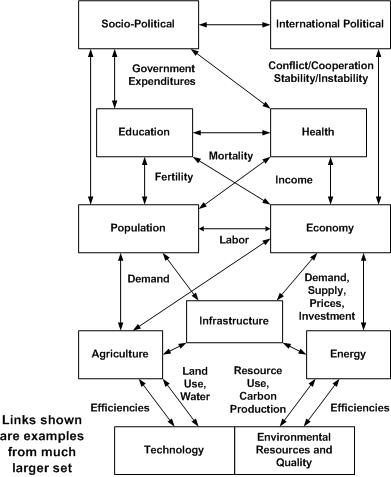
== IFs Issues and Modules: Visual Representation[[File:IFsOverviewChart.jpg|frame|right|Overview of the IFs model and sub-modules.]] ==
Among the philosophical premises of the International Futures (IFs) project is that the model cannot be a "black box" to users and be truly useful. Model users must be able to examine the structures of IFs in order (1) to have confidence in them, and (2) learn from them.
Among the philosophical premises of the International Futures (IFs) project is that the model cannot be a "black box" to users and be truly useful. Model users must be able to examine the structures of IFs in order (1) to have confidence in them, and (2) learn from them.
Line 36:
Line 36:
== Dominant relations ==
== Dominant relations ==
Any computer simulation or other model will have some relationships and dynamics that dominate the behavior of the model and that therefore most heavily influence the analyses done with the model. Understanding these dominant relations will facilitate model use, particularly in the definition of key or framing scenarios.[[File:IFsOverviewChart.jpg|frame|right|Overview of the IFs model and sub-modules.]]
Any computer simulation or other model will have some relationships and dynamics that dominate the behavior of the model and that therefore most heavily influence the analyses done with the model. Understanding these dominant relations will facilitate model use, particularly in the definition of key or framing scenarios.
The value added by more detailed specification of relationships in the model will lie partly in more probing analysis, often around specific policy options. Much of the value added by a more complete model specification will, however, lie in the dynamics of the full model.
The value added by more detailed specification of relationships in the model will lie partly in more probing analysis, often around specific policy options. Much of the value added by a more complete model specification will, however, lie in the dynamics of the full model.
Revision as of 18:54, 28 November 2016
Purposes
International Futures (IFs) is a tool for thinking about long-term global futures. It assists with:
Understanding the state of the world
Exploring trends and considering where they might be taking us
Learning about the dynamics of global systems
Thinking about the future we want to see:
Clarifying goals/priorities
Developing alternative scenarios (if-then statements) about the future
Investigating the leverage various agent-classes have in shaping the future
Assumptions that underlie IFs development and use:
Global issues are become more significant as the scope of human interaction and human impact on the broader environment grow
Goals and priorities for human systems are becoming clearer and are more frequently and consistently enunciated
Understanding of the dynamics of human systems is growing rapidly
The domain of human choice and action is broadening
What can you investigate with IFs? Examples include:
Social/Political Change: Life expectancy, literacy rate, democracy level, status of women, value change
Demographic Futures: Population levels and growth, fertility, mortality, migration
Food and Agriculture: Land use and production levels, calorie availability, malnutrition rates
Energy: Resource and production levels, demand patterns, renewable energy share
Economics: Sectoral production, consumption, and trade patterns and structural change
Global System: Country and regional power levels
IFs Issues and Modules: Visual RepresentationOverview of the IFs model and sub-modules.
Among the philosophical premises of the International Futures (IFs) project is that the model cannot be a "black box" to users and be truly useful. Model users must be able to examine the structures of IFs in order (1) to have confidence in them, and (2) learn from them.
Dominant relations
Any computer simulation or other model will have some relationships and dynamics that dominate the behavior of the model and that therefore most heavily influence the analyses done with the model. Understanding these dominant relations will facilitate model use, particularly in the definition of key or framing scenarios.
The value added by more detailed specification of relationships in the model will lie partly in more probing analysis, often around specific policy options. Much of the value added by a more complete model specification will, however, lie in the dynamics of the full model.
For an introductory summary of dominant relations and dynamics by submodule: