Carbon Data, Global Carbon Budget (GCB)
Summary
The Global Carbon Budget was founded by the Global Carbon Project international science team to track the trends in global carbon emissions and sinks and is a key measure of progress towards the goals of the Paris Agreement. The Global Carbon Budget Office is led by Professor Pierre Friedlingstein from the University of Exeter’s Global Systems Institute with the support of more than 100 people from 70 organizations in 18 countries. The budget is updated annually and published at the COP meetings every year. The source includes data for CO^2 emissions from coal, oil, gas, cement, flaring, bunkers, and the sum of all of those.
In July of 2025, the table SeriesEmissionsCarbonGCP was updated to replace EmissionsCarbonCDIAC as this series only provides data up to 2021. The Global Carbon Budget is updated annually ensuring data for more recent years. However, the Global Carbon Budget data only goes back to 1850 whereas EmissionsCarbonCDIAC has data up until 1751. Therefore, the research aide must blend the years 1751-1849 into SeriesEmissionsCarbonGCP.
Methodology:
The GCB uses CDIAC-FF’s data extended by 2–3 years using energy growth rates derived from data published by the Energy Institute as the starting point of the dataset. The GCB does do refinements if: there are official estimates available from developed countries as there is an assumption that those are of higher quality, if estimates from CDIAC-FF are in clear disagreement with those from other sources (like the IEA for example), if there is a final-year data available that provide higher quality estimates than by using growth rates derived from EI, and if the CDIAC-FF’s data contain implausible values.
Table In IFs
| Variable | Definition | Extended Source Definition | UsedInPreprocessor | UsedInPreprocessorFileName |
|---|---|---|---|---|
| SeriesEmissionsCarbonGCP | Fossil CO2 emissions by country (territorial) without land use. | National estimates include emissions from fossil fuel combustion and oxidation and cement production and excludes emissions from bunker fuels. | 1 | ENVIRONMENT |
Data Pulling Instructions
- Navigate to the site: https://globalcarbonbudget.org/
- The data is located in the boxed section. As the data is updated the year will change (next edition will be GCB 2025).
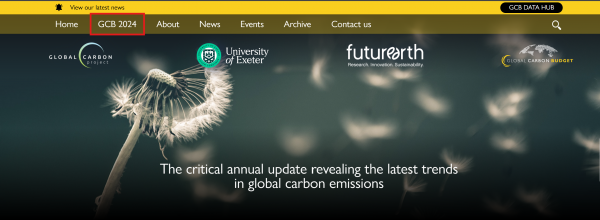
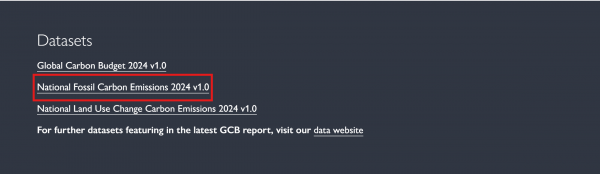
- Once you are in the page, scroll down until you get to the Datasets section. Click on the National Fossil Carbon Emissions Excel. The data will be in the sheet "Territorial Emissions." The data must be divided by 1,000 since the unit in the sheet is million tonnes of carbon and the unit in IFs is billion tonnes of carbon.


Data Notes
- If you would like to use a script to pull the data and calculate there is one linked here.